Introduction
Earlier, we introduced Bayesian inference and derived posterior distributions for
unknown parameters. Markov chains model sequential data, and Markov Chain Monte Carlo
(MCMC) methods use the Markov property to sample from complex posterior distributions.
So far, our development of Bayesian statistics has focused on inference: given observed data, how should we update our
beliefs about unknown quantities? But inference alone does not tell us what to do. In many applications we must ultimately
choose an action based on uncertain information. Medical diagnosis, spam filtering, and autonomous driving are typical examples.
Bayesian decision theory provides the principled framework for making such optimal decisions under uncertainty.
The setup is as follows. An agent must choose an action \(a\) from a set
of possible actions \(\mathcal{A}\). The consequence of this action depends on the unknown
state of nature \(h \in \mathcal{H}\), which the agent cannot observe directly.
To quantify the cost of choosing an action \(a\) when the true state is \(h\), we introduce
a loss function \(l(h, a)\).
The key idea of Bayesian decision theory is to combine the loss function with the posterior distribution
\(p(h \mid \boldsymbol{x})\) obtained from observed evidence \(\boldsymbol{x}\) (or a dataset \(\mathcal{D}\)).
For any action \(a\), the posterior expected loss (or posterior risk) is defined as follows.
Definition: Posterior Expected Loss
Given evidence \(\boldsymbol{x}\) and a loss function \(l(h, a)\), the posterior expected loss of
action \(a \in \mathcal{A}\) is
\[
\begin{align*}
\rho(a \mid \boldsymbol{x})
&= \mathbb{E}_{p(h \mid \boldsymbol{x})} [l(h, a)] \\\\
&= \sum_{h \in \mathcal{H}} l(h, a) \, p(h \mid \boldsymbol{x}).
\end{align*}
\]
When \(\mathcal{H}\) is continuous, the sum is replaced by an integral against the posterior density, as in the
continuous-parameter setting below. A rational agent should select the action that minimizes this expected loss. This leads to the
central concept of this page.
Definition: Bayes Estimator
The Bayes estimator (or Bayes decision rule / optimal policy) is the action
that minimizes the posterior expected loss:
\[
\pi^*(\boldsymbol{x}) = \arg\min_{a \in \mathcal{A}} \, \mathbb{E}_{p(h \mid \boldsymbol{x})}[l(h, a)].
\]
Equivalently, by defining the utility function \(U(h, a) = -l(h, a)\), which measures the desirability of each
action in each state, the Bayes estimator can be written as
\[
\pi^*(\boldsymbol{x}) = \arg\max_{a \in \mathcal{A}} \, \mathbb{E}_{p(h \mid \boldsymbol{x})}[U(h, a)].
\]
This utility-maximization formulation is natural in economics, game theory, and
reinforcement learning, where the focus is on maximizing expected
rewards rather than minimizing losses.
The power of this framework lies in its generality. By choosing different loss functions, we recover many familiar estimators and
decision rules as special cases. We will see three such recoveries in this page. For continuous parameters, squared-error loss yields
the posterior mean and absolute-error loss yields the posterior median. For discrete labels, zero-one loss yields the maximum a
posteriori (MAP) estimate, and this is the decision-theoretic justification for choosing the most probable class at inference time.
After establishing these special cases, we connect the Bayesian formulation above to its frequentist counterpart and show that, once
a prior is fixed, averaging the frequentist risk over that prior and minimizing posterior expected loss lead to the same optimal rule
under mild regularity.
Continuous Parameters: Squared and Absolute Error Loss
We first specialize the framework to the setting where the unknown state of nature is a continuous real-valued parameter. To match
standard usage in parametric statistics, we write \(\theta \in \Theta \subseteq \mathbb{R}\), with \(\Theta\) an interval, in place
of \(h \in \mathcal{H}\). The action space \(\mathcal{A}\) is also taken to be \(\Theta\), so that an action \(a\) is a candidate
value for \(\theta\). The interval assumption guarantees that the posterior mean and posterior median found below are themselves
available actions. This is the situation of
point estimation revisited from a decision-theoretic
standpoint. We treat the scalar case (\(\Theta \subseteq \mathbb{R}\)) for clarity of exposition.
The vector extension (\(\boldsymbol{\theta} \in \Theta \subseteq \mathbb{R}^k\) with squared-norm loss
\(\|\boldsymbol{\theta} - \boldsymbol{a}\|^2\)) follows the same logic.
Two loss functions are particularly natural in this setting: squared-error loss, which
penalizes large deviations heavily, and absolute-error loss, which is more robust to
outliers. Each leads to a familiar Bayesian point estimator as the corresponding optimal action.
Squared-Error Loss and the Posterior Mean
Definition: Squared-Error Loss
For a continuous parameter \(\theta \in \Theta\) and an action \(a \in \Theta\), the
squared-error loss is
\[
l_2(\theta, a) := (\theta - a)^2.
\]
Under this loss, the posterior expected loss admits a clean closed-form minimizer: the posterior mean.
Theorem: Posterior Mean Minimizes Posterior Expected Squared-Error Loss
Suppose the posterior \(p(\theta \mid \boldsymbol{x})\) has finite second moment, that is,
\(\mathbb{E}_{p(\theta \mid \boldsymbol{x})}[\theta^2] \lt \infty\). Then under squared-error loss, the posterior expected loss
\[
\rho(a \mid \boldsymbol{x}) = \mathbb{E}_{p(\theta \mid \boldsymbol{x})}[(\theta - a)^2]
\]
is uniquely minimized at the posterior mean
\[
a^* = \mathbb{E}_{p(\theta \mid \boldsymbol{x})}[\theta].
\]
Proof.
Expanding the square inside the expectation and using linearity,
\[
\rho(a \mid \boldsymbol{x}) = \mathbb{E}_{p(\theta \mid \boldsymbol{x})}[\theta^2] - 2 a \, \mathbb{E}_{p(\theta \mid \boldsymbol{x})}[\theta] + a^2.
\]
The first term does not depend on \(a\), and the remaining terms form a quadratic in \(a\). Differentiating with
respect to \(a\),
\[
\frac{d \rho(a \mid \boldsymbol{x})}{d a} = -2 \, \mathbb{E}_{p(\theta \mid \boldsymbol{x})}[\theta] + 2 a,
\]
and setting the derivative to zero gives \(a^* = \mathbb{E}_{p(\theta \mid \boldsymbol{x})}[\theta]\).
The second derivative is \(2 \gt 0\), so this critical point is the unique global minimum. The finite second-moment hypothesis
ensures that \(\rho(a \mid \boldsymbol{x})\) is finite (and hence the minimum is attained at a finite value).
The posterior mean is therefore the Bayes estimator under squared-error loss, often denoted \(\hat{\theta}_{\text{MMSE}}\)
(minimum mean squared error). The same algebra as in the bias-variance decomposition
\(\operatorname{MSE}(\hat{\theta}) = \operatorname{Var}(\hat{\theta}) + \operatorname{Bias}(\hat{\theta})^2\) of the
mean squared error, applied to the posterior instead of the
sampling distribution, gives
\[
\rho(a \mid \boldsymbol{x}) = \operatorname{Var}_{p(\theta \mid \boldsymbol{x})}[\theta] + (\mathbb{E}_{p(\theta \mid \boldsymbol{x})}[\theta] - a)^2,
\]
which makes the minimality of the posterior mean visible at a glance.
Absolute-Error Loss and the Posterior Median
Definition: Absolute-Error Loss
For a continuous parameter \(\theta \in \Theta\) and an action \(a \in \Theta\), the
absolute-error loss is
\[
l_1(\theta, a) := |\theta - a|.
\]
Squared-error loss penalizes large deviations more aggressively than small ones. A deviation of 2 incurs four times the loss of a
deviation of 1. Absolute-error loss is linear in the magnitude of the deviation and is therefore more robust when the posterior has
heavy tails. The optimal action under this loss is the posterior median.
Theorem: Posterior Median Minimizes Posterior Expected Absolute-Error Loss
Suppose the posterior \(p(\theta \mid \boldsymbol{x})\) has finite first moment, that is,
\(\mathbb{E}_{p(\theta \mid \boldsymbol{x})}[|\theta|] \lt \infty\), and admits a continuous CDF
\(F(a \mid \boldsymbol{x}) := \mathbb{P}(\theta \leq a \mid \boldsymbol{x})\). Then the posterior expected loss
\[
\rho(a \mid \boldsymbol{x}) = \mathbb{E}_{p(\theta \mid \boldsymbol{x})}[|\theta - a|]
\]
is minimized at any posterior median \(m^*\), that is, any value satisfying
\(F(m^* \mid \boldsymbol{x}) = \tfrac{1}{2}\).
Proof.
Split the loss into its two positive parts, \(|\theta - a| = (a - \theta)^+ + (\theta - a)^+\), and write each part as an
integral of an indicator:
\[
\begin{align*}
(a - \theta)^+ &= \int_{-\infty}^{a} \mathbb{1}\{\theta \leq t\} \, dt, \\\\
(\theta - a)^+ &= \int_{a}^{\infty} \mathbb{1}\{\theta \gt t\} \, dt.
\end{align*}
\]
Taking posterior expectations and interchanging the order of integration by
Tonelli's theorem (both integrands
are nonnegative), we obtain
\[
\begin{align*}
\mathbb{E}_{p(\theta \mid \boldsymbol{x})}[(a - \theta)^+] &= \int_{-\infty}^{a} F(t \mid \boldsymbol{x}) \, dt, \\\\
\mathbb{E}_{p(\theta \mid \boldsymbol{x})}[(\theta - a)^+] &= \int_{a}^{\infty} [1 - F(t \mid \boldsymbol{x})] \, dt.
\end{align*}
\]
Both sides are finite, since \(\rho(a \mid \boldsymbol{x}) \leq \mathbb{E}_{p(\theta \mid \boldsymbol{x})}[|\theta|] + |a|\) by
the finite-first-moment hypothesis. Hence
\[
\rho(a \mid \boldsymbol{x}) = \int_{-\infty}^{a} F(t \mid \boldsymbol{x}) \, dt + \int_{a}^{\infty} [1 - F(t \mid \boldsymbol{x})] \, dt.
\]
Since \(F(\cdot \mid \boldsymbol{x})\) is continuous, the fundamental theorem of calculus, which we take for granted here,
applies to both integrals and gives
\[
\frac{d \rho(a \mid \boldsymbol{x})}{d a} = F(a \mid \boldsymbol{x}) - [1 - F(a \mid \boldsymbol{x})] = 2 F(a \mid \boldsymbol{x}) - 1.
\]
Setting this to zero yields \(F(a \mid \boldsymbol{x}) = \tfrac{1}{2}\), that is, \(a^* = m^*\) is a posterior median. Since
\(F(\cdot \mid \boldsymbol{x})\) is nondecreasing, the derivative \(2 F(a \mid \boldsymbol{x}) - 1\) is nondecreasing in \(a\),
so \(\rho(\cdot \mid \boldsymbol{x})\) is convex and every critical point is a global minimum. The minimizer is unique whenever
\(F(\cdot \mid \boldsymbol{x})\) takes the value \(\tfrac{1}{2}\) at a single point, for instance when the posterior has a
density that is positive almost everywhere on an open interval around \(m^*\).
The Trio: MAP, Posterior Mean, Posterior Median
The three most common Bayesian point estimators correspond to three distinct loss functions:
- Zero-one loss (or, for continuous \(\theta\) and under regularity conditions on the posterior density, its
continuous limit) → MAP estimate (posterior mode), the action that maximizes the posterior density at a
single point.
- Squared-error loss → posterior mean, the action that minimizes mean-squared deviation
across the posterior.
- Absolute-error loss → posterior median, robust to heavy-tailed posteriors.
Far from being arbitrary heuristics, these three estimators are dictated by the choice of loss function (a median or a
mode need not be unique). In machine learning, this perspective explains why regression models trained with
mean-squared error implicitly target the conditional mean \(\mathbb{E}[y \mid \boldsymbol{x}]\), while quantile regression
trained with absolute-error loss targets the conditional median. The difference is not a matter of taste but a decision-theoretic
consequence of the chosen loss. (The connection between minimizing posterior expected loss as in our theorems above and
minimizing expected loss against the data-generating distribution as in machine learning practice is formalized in
the next section.)
Frequentist Risk, Bayes Risk, and Minimax
So far we have framed decision theory from the Bayesian perspective. Given observed data, we minimize the expected loss
with respect to the posterior. The classical, or frequentist, perspective inverts this conditioning.
There, the parameter \(\theta\) is treated as an unknown but fixed quantity, and the data \(\boldsymbol{x}\) is
treated as random. We evaluate a decision rule by averaging its loss over hypothetical data realizations drawn from the
data-generating distribution \(p(\boldsymbol{x} \mid \theta)\).
These two perspectives appear to start from opposite premises, yet they are connected by a precise equivalence theorem. Establishing
this equivalence is the central goal of this section. Along the way, we will introduce minimax, the third major
notion of optimality, and discuss its interpretation as a worst-case guarantee.
Convention. Throughout this section, we work in the parametric setting introduced for continuous parameters above,
but allow \(\theta \in \Theta\) to be either scalar- or vector-valued. The state of nature is the parameter \(\theta\) (replacing the
general \(h \in \mathcal{H}\) of the introduction), and a decision rule is a measurable function
\(\delta : \mathcal{X} \to \mathcal{A}\) mapping data to actions. When \(\mathcal{A} = \Theta\), the decision rule is exactly a
point estimator in the sense of statistical inference.
Whereas \(\pi^*(\boldsymbol{x})\) denoted the optimal decision rule under a given criterion, we now use \(\delta\) for an
arbitrary candidate decision rule whose risk we wish to evaluate. Optimality will then be defined as minimization of one of
several risk notions introduced below.
Frequentist Risk
Definition: Frequentist Risk
Let \(\delta : \mathcal{X} \to \mathcal{A}\) be a decision rule, and let \(l(\theta, a)\) be a loss function. The
frequentist risk of \(\delta\) at parameter value \(\theta\) is the expected loss when the data is
drawn from \(p(\boldsymbol{x} \mid \theta)\):
\[
\begin{align*}
R(\theta, \delta)
&:= \mathbb{E}_{p(\boldsymbol{x} \mid \theta)}[l(\theta, \delta(\boldsymbol{x}))] \\\\
&= \int l(\theta, \delta(\boldsymbol{x})) \, p(\boldsymbol{x} \mid \theta) \, d\boldsymbol{x}.
\end{align*}
\]
Three observations clarify the role of this definition. First, the parameter \(\theta\) is held fixed while the data is averaged
over, which is the opposite conditioning from the posterior expected loss \(\rho(a \mid \boldsymbol{x})\). Second,
\(R(\theta, \delta)\) is a function of \(\theta\). A single decision rule produces a risk function over the entire
parameter space, not a single number. Third, comparing two decision rules therefore requires comparing two functions, and one risk
curve may be lower for some \(\theta\) but higher for others. This last observation motivates the notions of admissibility and
minimax developed below.
Worked Example: Estimating a Gaussian Mean
To make the definition concrete, consider the canonical setting of estimating the mean of a Gaussian. Suppose data
\(x_1, \ldots, x_N \overset{\text{i.i.d.}}{\sim} \mathcal{N}(\theta, \sigma^2)\) with \(\sigma^2\) known, and suppose we use the
squared-error loss \(l_2(\theta, a) = (\theta - a)^2\). The corresponding risk is the mean squared error
\[
R(\theta, \delta) = \mathbb{E}_{p(\boldsymbol{x} \mid \theta)}\!\left[(\theta - \delta(\boldsymbol{x}))^2\right] = \operatorname{MSE}(\delta).
\]
From the decomposition of the mean squared error into variance and
squared bias (where, in the language of estimators, \(\hat{\theta} = \delta(\boldsymbol{x})\)),
\[
\operatorname{MSE}(\delta) = \operatorname{Var}_{p(\boldsymbol{x} \mid \theta)}[\delta(\boldsymbol{x})] + \operatorname{Bias}(\delta)^2,
\]
where \(\operatorname{Bias}(\delta) := \mathbb{E}_{p(\boldsymbol{x} \mid \theta)}[\delta(\boldsymbol{x})] - \theta\). We use this
identity to compute the risk of three estimators.
(i) The sample mean \(\delta_1(\boldsymbol{x}) = \bar{x} = \tfrac{1}{N}\sum_n x_n\). By
linearity of expectation,
\(\mathbb{E}[\bar{x}] = \theta\) (unbiased), and by the
variance of a sum of independent
variables, \(\operatorname{Var}[\bar{x}] = \sigma^2/N\). Hence
\[
R(\theta, \delta_1) = \frac{\sigma^2}{N}.
\]
The risk is constant in \(\theta\). The quality of the sample mean as an estimator does not depend on the true value.
(ii) The constant estimator \(\delta_2(\boldsymbol{x}) = \theta_0\) for some fixed
\(\theta_0 \in \mathbb{R}\). The variance is zero, but the bias is \(\theta_0 - \theta\), giving
\[
R(\theta, \delta_2) = (\theta_0 - \theta)^2.
\]
The risk is zero when \(\theta = \theta_0\) (a perfect guess) and grows quadratically as \(\theta\) moves away.
(iii) The shrinkage estimator \(\delta_3(\boldsymbol{x}) = w \bar{x} + (1 - w) \theta_0\), a convex combination of
the sample mean and the fixed value \(\theta_0\) with shrinkage weight \(w \in (0, 1)\). At this stage we treat \(w\) as an arbitrary
tuning parameter. We will see momentarily that one particular choice arises from a Bayesian construction. Computing the bias,
\[
\mathbb{E}_{p(\boldsymbol{x} \mid \theta)}[\delta_3] - \theta = w\theta + (1-w)\theta_0 - \theta = (1-w)(\theta_0 - \theta),
\]
and the variance \(\operatorname{Var}[\delta_3] = w^2 \sigma^2 / N\), we obtain
\[
R(\theta, \delta_3) = w^2 \frac{\sigma^2}{N} + (1-w)^2 (\theta_0 - \theta)^2.
\]
The risk interpolates between the two extremes: \(w = 1\) recovers the sample mean and \(w = 0\) recovers the constant estimator.
Bayesian origin of the shrinkage weight. The estimator \(\delta_3\) arises naturally as the posterior mean under a
Gaussian prior \(\theta \sim \mathcal{N}(\theta_0, \tau^2)\) (with known data variance \(\sigma^2\)). The resulting posterior is
again Gaussian, and its mean is the convex combination \(\delta_3\) with the specific weight
\[
w = \frac{N\tau^2}{N\tau^2 + \sigma^2}.
\]
A diffuse prior (large \(\tau^2\)) gives \(w \to 1\), so the data dominates and \(\delta_3 \to \delta_1\). A sharp prior
(small \(\tau^2\)) gives \(w \to 0\), so the prior dominates and \(\delta_3 \to \delta_2\). The full derivation appears
in our treatment of the Normal model with known variance.
Comparing the three risk functions reveals a fundamental phenomenon. The sample mean \(\delta_1\) has the lowest risk when
\(\theta\) is far from \(\theta_0\) (since the squared-bias term in \(\delta_3\) grows quadratically in \(|\theta - \theta_0|\)
while the risk of \(\delta_1\) stays at \(\sigma^2/N\)). The constant \(\delta_2\) achieves zero risk only at the single point
\(\theta = \theta_0\) and is uniformly worse than \(\delta_3\) outside a small neighborhood of \(\theta_0\) (the explicit threshold
can be computed by setting \(R(\theta, \delta_2) = R(\theta, \delta_3)\)).
The shrinkage estimator \(\delta_3\) is optimal in an intermediate range. There \(\theta\) is close enough to \(\theta_0\) to benefit
from the prior but not so close that \(\delta_2\) overtakes it. No single estimator is uniformly best, and the optimal choice depends
on the unknown true \(\theta\).
Admissibility in Action
We have just observed that no single risk curve dominates all others. This is exactly the situation that the formal notion of
admissibility is designed to capture. The constant estimator \(\delta_2\) is not dominated by either \(\delta_1\) or
\(\delta_3\), because at the single point \(\theta = \theta_0\) it achieves zero risk while the others do not. Yet \(\delta_2\)
is also clearly a poor estimator in any reasonable sense, since it ignores the data entirely. Admissibility therefore identifies
a necessary rationality condition (a dominated rule should never be used) but not a sufficient one (admissible
rules can still be terrible).
Definition: Admissibility
A decision rule \(\delta'\) is said to dominate another decision rule \(\delta\) if
\[
R(\theta, \delta') \leq R(\theta, \delta) \quad \text{for all } \theta \in \Theta,
\]
with strict inequality \(R(\theta_0, \delta') \lt R(\theta_0, \delta)\) for at least one \(\theta_0 \in \Theta\). A decision rule
\(\delta\) is admissible if no decision rule dominates it. Otherwise \(\delta\) is
inadmissible.
Admissibility is a partial-order criterion. It rules out estimators that are uniformly worse than some alternative, but typically
leaves an entire family of admissible candidates from which to choose. To select among admissible rules, one needs an additional
principle. Two such principles are averaging the risk over a prior (the Bayesian solution) and worst-casing it over \(\theta\)
(the minimax solution).
Bayes Risk and the Equivalence Theorem
The Bayesian approach to selecting among decision rules averages the frequentist risk against a prior
distribution \(p(\theta)\), collapsing the risk function to a single number per rule.
Definition: Bayes Risk
Let \(p(\theta)\) be a prior distribution on the parameter space \(\Theta\), and let \(\delta\) be
a decision rule. The Bayes risk of \(\delta\) under prior \(p\) is
\[
r(p, \delta) := \mathbb{E}_{p(\theta)}[R(\theta, \delta)] = \int R(\theta, \delta) \, p(\theta) \, d\theta.
\]
A decision rule that minimizes \(r(p, \cdot)\) over all decision rules is called a
Bayes rule with respect to the prior \(p\).
The Bayes risk is an integral over both \(\theta\) and \(\boldsymbol{x}\):
\[
r(p, \delta) = \int \int l(\theta, \delta(\boldsymbol{x})) \, p(\boldsymbol{x} \mid \theta) \, p(\theta) \, d\boldsymbol{x} \, d\theta.
\]
The next theorem, the central result of this section, shows that this minimization problem reduces to a pointwise one. For each fixed
\(\boldsymbol{x}\), we choose the action that minimizes the posterior expected loss. This is the precise sense in which, once a prior
is fixed, Bayesian and frequentist optimality coincide.
Theorem: Bayes Rule via Pointwise Posterior Minimization
Suppose the loss \(l(\theta, a)\) is jointly measurable and the joint integrability condition
\[
\int \int |l(\theta, \delta(\boldsymbol{x}))| \, p(\boldsymbol{x} \mid \theta) \, p(\theta) \, d\boldsymbol{x} \, d\theta \lt \infty
\]
holds for any decision rule \(\delta\) we wish to evaluate (so that the Bayes risk \(r(p, \delta)\) is well-defined and Fubini's
theorem applies). Suppose further that the pointwise minimizer
\(a^*(\boldsymbol{x}) := \arg\min_{a \in \mathcal{A}} \rho(a \mid \boldsymbol{x})\) exists and is a measurable function of
\(\boldsymbol{x}\) (this holds, for example, when \(\mathcal{A}\) is a compact subset of a Euclidean space, \(l\) is continuous
in \(a\), and \(|l(\theta, a)| \leq g(\theta)\) for some measurable \(g \geq 0\) with
\(\int g(\theta)\, p(\theta \mid \boldsymbol{x})\, d\theta \lt \infty\) for every \(\boldsymbol{x}\), by a measurable selection
argument that we do not develop).
Then minimizing the Bayes risk \(r(p, \delta)\) is equivalent to minimizing the posterior expected loss pointwise. A Bayes rule
is given by
\[
\begin{align*}
\delta^*(\boldsymbol{x})
&= \arg\min_{a \in \mathcal{A}} \, \mathbb{E}_{p(\theta \mid \boldsymbol{x})}[l(\theta, a)] \\\\
&= \arg\min_{a \in \mathcal{A}} \rho(a \mid \boldsymbol{x})
\end{align*}
\]
for almost every \(\boldsymbol{x}\) under the marginal evidence
\(p(\boldsymbol{x}) := \int p(\boldsymbol{x} \mid \theta) \, p(\theta) \, d\theta\).
Proof.
By definition,
\[
r(p, \delta) = \int \int l(\theta, \delta(\boldsymbol{x})) \, p(\boldsymbol{x} \mid \theta) \, p(\theta) \, d\boldsymbol{x} \, d\theta.
\]
The joint integrability hypothesis allows us to apply
Fubini's theorem to interchange the
order of integration. Using Bayes' theorem in its
density form \(p(\boldsymbol{x} \mid \theta) p(\theta) = p(\theta \mid \boldsymbol{x}) p(\boldsymbol{x})\), which we assume
without proof here (the linked statement is the version for events), the identity being valid wherever
\(p(\boldsymbol{x}) \gt 0\), and the null set \(\{p(\boldsymbol{x}) = 0\}\) contributes nothing to the integral, we obtain
\[
\begin{align*}
r(p, \delta)
&= \int \left[ \int l(\theta, \delta(\boldsymbol{x})) \, p(\theta \mid \boldsymbol{x}) \, d\theta \right] p(\boldsymbol{x}) \, d\boldsymbol{x} \\\\
&= \int \rho(\delta(\boldsymbol{x}) \mid \boldsymbol{x}) \, p(\boldsymbol{x}) \, d\boldsymbol{x}.
\end{align*}
\]
It remains to show that the decision rule \(\delta^*(\boldsymbol{x}) := a^*(\boldsymbol{x})\) attains the minimum of this
integral. By the definition of \(a^*(\boldsymbol{x})\) as the pointwise minimizer, for any decision rule \(\delta\) we have
the pointwise inequality
\[
\rho(\delta(\boldsymbol{x}) \mid \boldsymbol{x}) \geq \rho(a^*(\boldsymbol{x}) \mid \boldsymbol{x}) \quad \text{for every } \boldsymbol{x}.
\]
Multiplying by \(p(\boldsymbol{x}) \geq 0\) and integrating preserves the inequality (monotonicity of the integral), giving
\[
\begin{align*}
r(p, \delta)
&= \int \rho(\delta(\boldsymbol{x}) \mid \boldsymbol{x}) \, p(\boldsymbol{x}) \, d\boldsymbol{x} \\\\
&\geq \int \rho(a^*(\boldsymbol{x}) \mid \boldsymbol{x}) \, p(\boldsymbol{x}) \, d\boldsymbol{x} \\\\
&= r(p, \delta^*).
\end{align*}
\]
Hence \(\delta^*\) is a Bayes rule, and equality holds if and only if
\(\rho(\delta(\boldsymbol{x}) \mid \boldsymbol{x}) = \rho(a^*(\boldsymbol{x}) \mid \boldsymbol{x})\) for
\(p(\boldsymbol{x})\)-almost every \(\boldsymbol{x}\), that is, if and only if \(\delta(\boldsymbol{x})\) is itself a pointwise
minimizer for \(p(\boldsymbol{x})\)-almost every \(\boldsymbol{x}\).
Why This Equivalence Matters
The Bayes-rule-via-posterior theorem is the conceptual bridge between two seemingly opposed schools of statistics. The
frequentist averages loss over hypothetical data, while the Bayesian conditions on observed data and averages over the
parameter. Yet the optimal decision rule is the same in both cases (under a chosen prior). This is the technical foundation for
the slogan that Bayesian methods provide a constructive way of achieving frequentist goals.
For machine learning, the practical consequence is substantial. Instead of solving a hard optimization over the space of all
decision rules \(\delta : \mathcal{X} \to \mathcal{A}\), we may solve a much simpler optimization over actions
\(a \in \mathcal{A}\), separately for each input \(\boldsymbol{x}\) we encounter. This is exactly what a probabilistic classifier
does at inference time. It computes \(p(y \mid \boldsymbol{x})\) and then picks
\(\arg\max_y p(y \mid \boldsymbol{x})\), the Bayes rule under zero-one loss. The training-time procedure (for
example, cross-entropy minimization) is a separate matter that aims to learn the conditional distribution
\(p(y \mid \boldsymbol{x})\) itself, after which the present theorem dictates how to act on that distribution.
Maximum Risk and Minimax
The Bayes risk requires a prior, which a strict frequentist may consider unjustified. An alternative
is to evaluate a rule by its worst-case risk over all parameter values.
Definition: Maximum Risk
The maximum risk of a decision rule \(\delta\) is
\[
R_{\max}(\delta) := \sup_{\theta \in \Theta} R(\theta, \delta).
\]
Definition: Minimax Rule
A decision rule \(\delta_{\text{MM}}\) is called a minimax rule if it minimizes the
maximum risk:
\[
\delta_{\text{MM}} \in \arg\min_{\delta} R_{\max}(\delta) = \arg\min_{\delta} \sup_{\theta \in \Theta} R(\theta, \delta).
\]
The minimax criterion encodes a deeply pessimistic view. The decision-maker assumes that nature will select the worst possible
\(\theta\) against the chosen rule, and seeks to minimize the damage in this adversarial scenario. In the worked example above, the
maximum risks are easily computed: \(R_{\max}(\delta_1) = \sigma^2/N\) (the constant risk of the sample mean), while
\(R_{\max}(\delta_2) = +\infty\) and \(R_{\max}(\delta_3) = +\infty\) (since the squared-bias terms blow up as
\(|\theta - \theta_0| \to \infty\)). On the real line, \(\delta_1\) is therefore the minimax rule among these three candidates, not
because it is uniformly best but because it is the only one with bounded worst-case risk.
A deep result in classical decision theory connects the two optimality criteria. Under suitable regularity conditions (compactness
of \(\Theta\), continuity of the loss, and existence of a so-called least favorable prior, the prior against
which the smallest attainable Bayes risk is largest), every minimax rule arises as a Bayes rule against this least favorable
prior. The full statement and proof require additional machinery (saddle-point theory, complete-class theorems) and are beyond the
scope of this page.
Why Minimax Is Not the Default
The minimax criterion is nevertheless rarely used in practice, for two reasons. First, it is computationally hard, since
identifying the worst-case \(\theta\) generally requires solving a saddle-point problem. Second, and more fundamentally, the
implicit assumption that nature is an adversary is unrealistic in most statistical settings. In game-theoretic contexts
(adversarial machine learning, robust optimization, security applications), where an actual adversary chooses the worst-case
input, minimax becomes natural. For inference about a fixed but unknown \(\theta\), averaging over a prior (Bayes) or selecting
among admissible rules tends to give more useful answers.
Classification (Zero-One Loss)
Perhaps the most common application of Bayesian decision theory in machine learning is classification. Given an
input \(\boldsymbol{x} \in \mathcal{X}\), we wish to assign it the optimal class label. We now return to the discrete-label
setting of the introduction (rather than the continuous-parameter setting of the previous two sections), where the state of
nature is the unknown true class label. To apply the general framework, we specify the states, actions, and loss function for
this particular setting.
Suppose that the states of nature correspond to class labels
\[
\mathcal{H} = \mathcal{Y} = \{1, \ldots, C\},
\]
and that the possible actions are also the class labels: \(\mathcal{A} = \mathcal{Y}\).
A natural loss function in this context is the zero-one loss, which penalizes
misclassification equally regardless of which classes are confused.
Definition: Zero-One Loss
The zero-one loss is defined as
\[
l_{01}(y^*, \hat{y}) = \mathbb{1}\{y^* \neq \hat{y}\},
\]
where \(y^*\) is the true label and \(\hat{y}\) is the predicted label.
Notation. In this classification context, we use the starred symbol \(y^*\) to emphasize the true (but unknown)
class label, and \(\hat{y}\) for the predicted label. This parallels the estimator notation \(\hat{\theta}\) for the predicted value
of an unknown parameter. The asterisk plays a purely notational role here and does not change the meaning of the symbol.
Under the zero-one loss, the posterior expected loss for choosing label \(\hat{y}\) becomes
\[
\rho(\hat{y} \mid \boldsymbol{x}) = p(\hat{y} \neq y^* \mid \boldsymbol{x}) = 1 - p(y^* = \hat{y} \mid \boldsymbol{x}).
\]
Thus, minimizing the expected loss is equivalent to maximizing the posterior probability:
\[
\pi^*(\boldsymbol{x}) = \arg\max_{y \in \mathcal{Y}} \, p(y \mid \boldsymbol{x}).
\]
In other words, the optimal decision under zero-one loss is to select the mode of the posterior distribution. We
call this the maximum a posteriori (MAP) estimate. Zero-one loss thus supplies the decision-theoretic justification
for reporting the most probable class.
The Reject Option
In some scenarios the cost of an incorrect classification may be so high that it is preferable for the system to abstain from making
a decision when it is uncertain. Such scenarios include safety-critical applications such as medical diagnosis or autonomous driving.
The reject option formalizes this abstention.
Under this approach, the set of available actions is expanded to include a reject action:
\[
\mathcal{A} = \mathcal{Y} \cup \{0\},
\]
where action \(0\) represents the reject option, that is, declining to assign a label. The loss function is then defined as
\[
l(y^*, a) =
\begin{cases}
0 & \text{if } y^* = a \text{ and } a \in \{1, \ldots, C\} \\\\
\lambda_r & \text{if } a = 0 \\\\
\lambda_e & \text{otherwise}
\end{cases}
\]
where \(\lambda_r\) is the cost of the reject action and \(\lambda_e\) is the cost of a classification error.
For the reject option to be meaningful, we require \(0 \lt \lambda_r \lt \lambda_e\). Otherwise rejecting is either free (and we
would always reject) or more expensive than guessing (and we would never reject).
Under this framework, instead of always choosing the label with the highest posterior probability, the optimal policy chooses a label
only when the classifier is sufficiently confident:
\[
a^* =
\begin{cases}
\hat{y}^* & \text{if } p^* \gt \lambda^* \\\\
\text{reject} & \text{otherwise}
\end{cases}
\]
where
\[
\begin{align*}
\hat{y}^* &:= \arg\max_{y \in \{1, \ldots, C\}} p(y \mid \boldsymbol{x}), \\\\
p^* &:= p(\hat{y}^* \mid \boldsymbol{x}) = \max_{y \in \{1, \ldots, C\}} p(y \mid \boldsymbol{x}), \\\\
\lambda^* &:= 1 - \frac{\lambda_r}{\lambda_e}.
\end{align*}
\]
Proof.
The optimal action minimizes the posterior expected loss \(\rho(a \mid \boldsymbol{x})\) over
\(a \in \mathcal{A} = \mathcal{Y} \cup \{0\}\). We compute this in two stages. First, we find the best candidate among the class
labels. Second, we compare it against the reject option.
Step 1 (best class label). For any class label \(y \in \{1, \ldots, C\}\), the loss function above gives
\(l(y^*, y) = \lambda_e\) when \(y^* \neq y\) and \(l(y, y) = 0\). Hence
\[
\begin{align*}
\rho(y \mid \boldsymbol{x})
&= \mathbb{E}_{p(y^* \mid \boldsymbol{x})}[l(y^*, y)] \\\\
&= \lambda_e \sum_{y^* \neq y} p(y^* \mid \boldsymbol{x}) \\\\
&= \lambda_e \, [1 - p(y \mid \boldsymbol{x})].
\end{align*}
\]
Minimizing \(\rho(y \mid \boldsymbol{x})\) over \(y \in \{1, \ldots, C\}\) is equivalent to maximizing
\(p(y \mid \boldsymbol{x})\). The minimizer is therefore \(\hat{y}^* = \arg\max_y p(y \mid \boldsymbol{x})\), achieving
\(\rho(\hat{y}^* \mid \boldsymbol{x}) = \lambda_e \, [1 - p^*]\).
Step 2 (class label vs reject). The reject action \(a = 0\) incurs cost \(\lambda_r\) regardless of the true
class, so \(\rho(0 \mid \boldsymbol{x}) = \lambda_r\). Comparing the two candidates \(\hat{y}^*\) and \(0\), we choose
\(\hat{y}^*\) if and only if
\[
\begin{align*}
\rho(\hat{y}^* \mid \boldsymbol{x}) &\lt \rho(0 \mid \boldsymbol{x}) \\\\
\lambda_e \, [1 - p^*] &\lt \lambda_r \\\\
p^* &\gt 1 - \frac{\lambda_r}{\lambda_e} = \lambda^*.
\end{align*}
\]
Otherwise (\(p^* \leq \lambda^*\)), the reject action achieves the minimum expected loss.
Confusion Matrix
The Bayes estimator tells us what the optimal decision rule is, but in practice, we need to measure how well a
classifier actually performs on real data. The standard tool for this is the (class) confusion matrix, which
provides a complete summary of the outcomes of classification decisions. We recall the four possible outcomes from our
treatment of Type I and Type II errors
in statistical inference and hypothesis testing.
For binary classification (\(y \in \{0, 1\}\)), each prediction falls into one of four categories:
- True Positives (TP): instances correctly classified as positive.
- True Negatives (TN): instances correctly classified as negative.
- False Positives (FP): instances incorrectly classified as positive (Type I error).
- False Negatives (FN): instances incorrectly classified as negative (Type II error).
Understanding the distinction between FP and FN is critical because the costs associated with each error type may
differ significantly depending on the application. In safety-critical systems, a false negative (missing a dangerous
condition) is typically far more costly than a false positive (raising an unnecessary alarm). For example, in medical
screening, a false positive means unnecessarily alarming a healthy patient, whereas a false negative means failing to
detect a disease in someone who needs treatment.
Notation. In the confusion matrix below, \(P\) and \(N\) denote the total counts of actual positive and actual
negative instances respectively (with the hat versions \(\hat{P}\) and \(\hat{N}\) for the predicted totals), and \(M = P + N\) is
the total number of labeled examples. These symbols are local to this evaluation context and should not be confused with the
probability operator \(P(\cdot)\) of earlier pages.
Table 1: Confusion Matrix for Binary Classification
\[
\begin{array}{|c|c|c|}
\hline
& \textbf{Predicted Positive} \quad (\hat{P} = \text{TP} + \text{FP})
& \textbf{Predicted Negative} \quad (\hat{N} = \text{FN} + \text{TN}) \\\\
\hline
\textbf{Actual Positive} \quad (P = \text{TP} + \text{FN}) & \textbf{TP} & \textbf{FN} \\\\
\hline
\textbf{Actual Negative} \quad (N = \text{FP} + \text{TN}) & \textbf{FP} & \textbf{TN} \\\\
\hline
\end{array}
\]
In the context of Bayesian decision theory, the confusion matrix quantifies the empirical performance
of the Bayes estimator (or any other decision rule) by counting how often the predicted labels match or
mismatch the true labels.
In practice, a binary classifier typically outputs a probability \(p(y = 1 \mid \boldsymbol{x})\), and the final prediction depends
on a decision threshold \(\tau \in [0, 1]\). For any fixed threshold \(\tau\), the decision rule is
\[
\hat{y}_{\tau}(\boldsymbol{x}) = \mathbb{1}\{p(y = 1 \mid \boldsymbol{x}) \geq \tau\}.
\]
Given a set of \(M\) labeled examples, we can compute the empirical counts for each cell of the confusion matrix. For example,
\[
\begin{align*}
\text{FP}_{\tau} &= \sum_{n=1}^{M} \mathbb{1}\{\hat{y}_{\tau}(\boldsymbol{x}_n) = 1, \, y_n = 0\},\\\\
\text{FN}_{\tau} &= \sum_{n=1}^{M} \mathbb{1}\{\hat{y}_{\tau}(\boldsymbol{x}_n) = 0, \, y_n = 1\}.
\end{align*}
\]
Table 2: Threshold-Dependent Confusion Matrix
\[
\begin{array}{|c|c|c|}
\hline
& \hat{y}_{\tau}(\boldsymbol{x}_n) = 1
& \hat{y}_{\tau}(\boldsymbol{x}_n) = 0 \\\\
\hline
y_n = 1 & \text{TP}_{\tau} & \text{FN}_{\tau} \\\\
\hline
y_n = 0 & \text{FP}_{\tau} & \text{TN}_{\tau} \\\\
\hline
\end{array}
\]
Since the confusion matrix depends on the choice of \(\tau\), different thresholds lead to different trade-offs
between error types. How should we choose \(\tau\), and how can we evaluate a classifier's performance across all
possible thresholds? This motivates the ROC and PR curves developed in the following sections.
Receiver Operating Characteristic Curves
Rather than evaluating a classifier at a single threshold, we can characterize its performance across all thresholds
simultaneously. The receiver operating characteristic (ROC) curve achieves this by plotting two rates derived from
the confusion matrix. To obtain these rates, we normalize the confusion matrix per row, which yields the
conditional distribution \(p(\hat{y} \mid y)\). Since each row sums to 1, these rates describe the classifier's behavior separately
within the positive and negative populations.
Table 3: Confusion Matrix Normalized per Row
\[
\begin{array}{|c|c|c|}
\hline
& \hat{y}_{\tau}(\boldsymbol{x}_n) = 1 & \hat{y}_{\tau}(\boldsymbol{x}_n) = 0 \\\\
\hline
y_n = 1 & \text{TP}_{\tau} / P = \text{TPR}_{\tau} & \text{FN}_{\tau} / P = \text{FNR}_{\tau} \\\\
\hline
y_n = 0 & \text{FP}_{\tau} / N = \text{FPR}_{\tau} & \text{TN}_{\tau} / N = \text{TNR}_{\tau} \\\\
\hline
\end{array}
\]
Notation. Each rate below is defined as an empirical ratio of counts. For large \(M\), the law of large
numbers identifies it with the corresponding population conditional probability, which we write as
\(p(\hat{y}_\tau = \cdot \mid y = \cdot)\) using \(\tau\) as a subscript on the prediction rather than as a conditioning event (since
\(\tau\) is a fixed parameter, not a random variable).
- True positive rate (TPR) (or Sensitivity / Recall): \[
\text{TPR}_{\tau} := \frac{\text{TP}_{\tau}}{\text{TP}_{\tau} + \text{FN}_{\tau}} \approx p(\hat{y}_\tau = 1 \mid y = 1).
\]
- False positive rate (FPR) (or Type I error rate / Fallout): \[
\text{FPR}_{\tau} := \frac{\text{FP}_{\tau}}{\text{FP}_{\tau} + \text{TN}_{\tau}} \approx p(\hat{y}_\tau = 1 \mid y = 0).
\]
- False negative rate (FNR) (or Type II error rate / Miss rate):\[
\text{FNR}_{\tau} := \frac{\text{FN}_{\tau}}{\text{TP}_{\tau} + \text{FN}_{\tau}} \approx p(\hat{y}_\tau = 0 \mid y = 1).
\]
- True negative rate (TNR) (or Specificity):\[
\text{TNR}_{\tau} := \frac{\text{TN}_{\tau}}{\text{FP}_{\tau} + \text{TN}_{\tau}} \approx p(\hat{y}_\tau = 0 \mid y = 0).
\]
By plotting TPR against FPR as a parametric curve in \(\tau\), we obtain the ROC curve.
The overall quality of a classifier is often summarized using the AUC (Area Under the Curve).
A higher AUC indicates better discriminative ability aggregated over all threshold values, with a maximum of 1.0 for a
perfect classifier.
The figure below compares two classifiers, one trained using logistic regression and the other using a random forest. Both
classifiers provide predicted probabilities for the positive class, so we can vary \(\tau\) and compute the corresponding
TPR and FPR.
A diagonal line is also drawn. It represents a random classifier, that is, one that assigns labels purely by chance. On this line,
the TPR equals the FPR at every threshold. If a classifier's ROC curve lies on this diagonal, it means the classifier is performing
no better than random guessing. In contrast, any performance above the diagonal indicates that the classifier is capturing some
signal, while performance below the diagonal (rare in practice) would indicate worse-than-random behavior.
In our demonstration, the logistic regression model has been intentionally made worse and yields an AUC of 0.78, while the random
forest shows superior performance with an AUC of 0.94. These results mean that, overall, the random forest is much better at
distinguishing between the positive and negative classes compared to the underperforming logistic regression model.
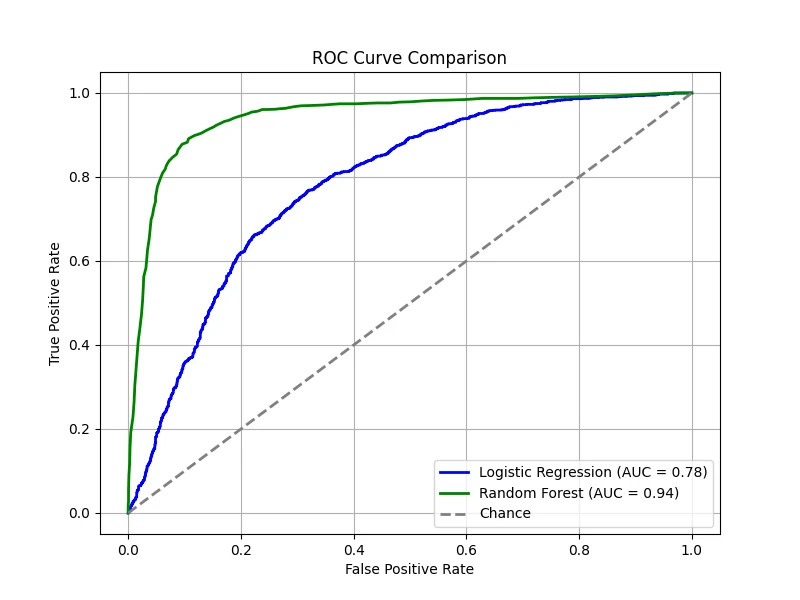
(Data: 10,000 samples, 20 total features, 5 features are informative, 2 clusters per class, 5% label noise.)
Equal Error Rate (EER)
The ROC curve provides a comprehensive view of the trade-off between TPR and FPR, but it can be useful to summarize this trade-off
with a single number. The equal error rate (EER) is the operating point where \(\text{FPR} = \text{FNR}\), the
threshold at which the two error rates are symmetric. EER is a practical operating-point summary that does not assume a
particular cost structure or class prior. It is determined by the two error rates alone.
Note. The EER is generally not the Bayes-optimal threshold. Under equal misclassification costs, the
Bayes-optimal threshold corresponds to a posterior probability of \(1/2\) whatever the class prior, since the posterior already
accounts for it, and it depends on the calibration of the classifier's score, not on the FPR/FNR symmetry.
EER is particularly useful in applications such as biometric authentication (fingerprint or face recognition), where a single
interpretable operating point is desired for system reporting.
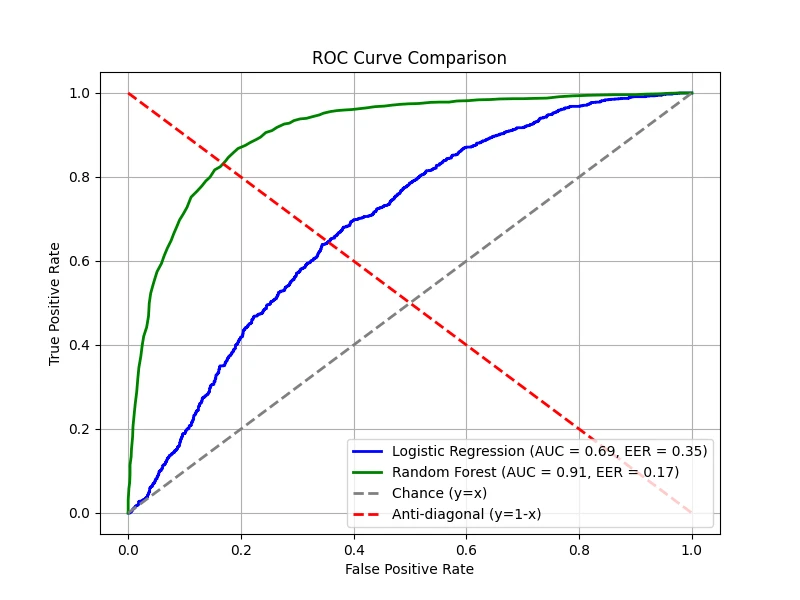
The figure below shows the EER point for our two models, that is, the point where the FPR and FNR curves intersect:
A perfect classifier would achieve an EER of 0, which corresponds to the top-left corner of the ROC curve. In practice, one may tune
the decision threshold to operate at or near the EER, depending on the application's requirements.
The ROC curve and EER evaluate a classifier by conditioning on the true class (that is, how the classifier behaves within each
population). However, in many practical settings we care about a different question:
given that the classifier predicted positive, how likely is it to be correct? This leads us to precision-recall analysis.
Precision-Recall (PR) Curves
Here, we normalize the confusion matrix per column to obtain \(p(y \mid \hat{y})\), which conditions
on the predicted label. The column-normalized confusion matrix answers a complementary question:
among the instances predicted as positive (or negative), what fraction are truly positive (or negative)?
This perspective is especially important when precision is critical, such as in medical diagnosis or fraud detection.
Table 4: Confusion Matrix Normalized per Column
\[
\begin{array}{|c|c|c|}
\hline
& \hat{y}_{\tau}(\boldsymbol{x}_n) = 1 & \hat{y}_{\tau}(\boldsymbol{x}_n) = 0 \\\\
\hline
y_n = 1 & \text{TP}_{\tau} / \hat{P} = \text{PPV}_{\tau} & \text{FN}_{\tau} / \hat{N} = \text{FOR}_{\tau} \\\\
\hline
y_n = 0 & \text{FP}_{\tau} / \hat{P} = \text{FDR}_{\tau} & \text{TN}_{\tau} / \hat{N} = \text{NPV}_{\tau} \\\\
\hline
\end{array}
\]
- Positive predictive value (PPV) (or Precision):\[
\text{PPV}_{\tau} := \frac{\text{TP}_{\tau}}{\text{TP}_{\tau} + \text{FP}_{\tau}} \approx p(y = 1 \mid \hat{y}_\tau = 1).
\]
- False discovery rate (FDR):\[
\text{FDR}_{\tau} := \frac{\text{FP}_{\tau}}{\text{TP}_{\tau} + \text{FP}_{\tau}} \approx p(y = 0 \mid \hat{y}_\tau = 1).
\]
- False omission rate (FOR):\[
\text{FOR}_{\tau} := \frac{\text{FN}_{\tau}}{\text{FN}_{\tau} + \text{TN}_{\tau}} \approx p(y = 1 \mid \hat{y}_\tau = 0).
\]
- Negative predictive value (NPV):\[
\text{NPV}_{\tau} := \frac{\text{TN}_{\tau}}{\text{FN}_{\tau} + \text{TN}_{\tau}} \approx p(y = 0 \mid \hat{y}_\tau = 0).
\]
Note that within each column, the rates sum to 1: \(\text{PPV} + \text{FDR} = 1\)
and \(\text{FOR} + \text{NPV} = 1\).
To summarize a system's performance, we often use a precision-recall (PR) curve. It is especially informative when
classes are imbalanced (that is, when the positive class is rare) or when false positives and false negatives have
different costs. This curve plots precision against recall as the decision threshold \(\tau\) varies.
Let precision be \(\mathcal{P}(\tau)\) and recall be \(\mathcal{R}(\tau)\). For binary labels \(\hat{y}_n, y_n \in \{0, 1\}\), at
threshold \(\tau\) these are computed as
\[
\begin{align*}
\mathcal{P}(\tau) &:= \frac{\sum_n y_n \hat{y}_n}{\sum_n \hat{y}_n} = \text{PPV}_\tau, \\\\
\mathcal{R}(\tau) &:= \frac{\sum_n y_n \hat{y}_n}{\sum_n y_n} = \text{TPR}_\tau,
\end{align*}
\]
using \(\mathcal{P}, \mathcal{R}\) (calligraphic) for the precision and recall functions of \(\tau\). These are the same quantities
as the \(\text{PPV}_\tau\) and \(\text{TPR}_\tau\) introduced earlier, renamed in keeping with standard machine-learning terminology
and to emphasize their role as functions of \(\tau\) when plotting curves. (The calligraphic \(\mathcal{P}\) is local to this section
and is unrelated to the count \(P\) of actual positives or to the probability operator.)
By plotting \(\mathcal{P}(\tau)\) against \(\mathcal{R}(\tau)\) as \(\tau\) varies, we obtain the PR curve.
A crucial difference between the ROC and PR curves is the baseline for a random classifier. While a random
classifier yields an AUC of 0.5 in expectation on an ROC curve, the baseline for a PR curve is the fraction of
positive samples in the dataset:
\[
y_{\text{baseline}} = \frac{P}{P + N}.
\]
To see why, consider a random classifier that predicts positive with a constant probability \(q\) (independent of the input). On
average it achieves \(\text{TP} = qP\) and \(\text{FP} = qN\), so its precision is
\(\text{TP}/(\text{TP}+\text{FP}) = qP/(qP + qN) = P/(P+N)\) regardless of \(q \in (0, 1]\). Varying \(q\) sweeps recall over
\((0, 1]\) while precision stays constant, and so traces a horizontal line at this baseline. This makes the PR curve a much more
informative evaluation tool for highly imbalanced datasets, as the "no-knowledge" score can be near zero while the "perfect"
score remains 1.0.
However, raw precision values can be noisy as the threshold varies. To stabilize this, interpolated precision is
often computed. For a given recall level \(r\), it is defined as the maximum precision observed for any recall level greater than or
equal to \(r\):
\[
\mathcal{P}_{\text{interp}}(r) := \max_{r' \geq r} \mathcal{P}(r').
\]
One common definition of the average precision (AP) is the area under this interpolated PR curve. It provides a
single-number summary that reflects the classifier's ability to maintain high precision as recall increases (that is, as the decision
threshold \(\tau\) is lowered).
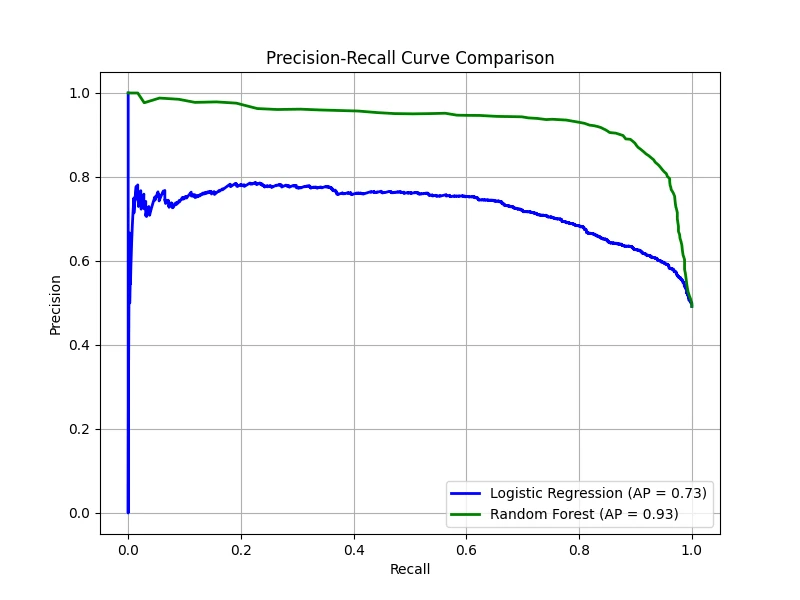
In our case, the logistic regression produced an AP of 0.73, while the random forest achieved a much stronger AP of 0.93. This
indicates that the random forest is significantly more robust at identifying positive cases without sacrificing precision.
Note. In settings where multiple PR curves are generated (for example, one for each query in information retrieval or one per class in
multi-class classification), the mean average precision (mAP) is computed as the mean of the AP scores over all
curves. mAP offers an overall performance measure across multiple queries or classes.
Class Imbalance
In many real-world applications, the class distribution is far from uniform. A dataset is considered imbalanced when
one class has significantly fewer examples than the other, for instance 5% positive samples and 95% negative samples. In such cases,
naive metrics like accuracy can be highly misleading. A model that always predicts the majority class achieves high accuracy without
correctly identifying any minority class instances. How do ROC-AUC and PR-AP behave differently under class imbalance?
The ROC-AUC metric is relatively insensitive to class imbalance at the population level, because
both TPR and FPR are computed within their respective populations. TPR is a ratio within the positive samples and FPR is a ratio
within the negative samples. Consequently, the class proportions do not directly affect the population ROC curve. (In practice,
however, empirical AUC estimates can become noisy when one class is severely under-represented, since the minority sample provides
few examples for stable estimation.)
On the other hand, the PR-AP metric is more sensitive to class imbalance.
This is because precision depends on both populations:
\[
\text{Precision} = \frac{\text{TP}}{\text{TP} + \text{FP}}.
\]
When the negative class vastly outnumbers the positive class, even a small false positive
rate can produce a large absolute number of false positives, significantly reducing precision.
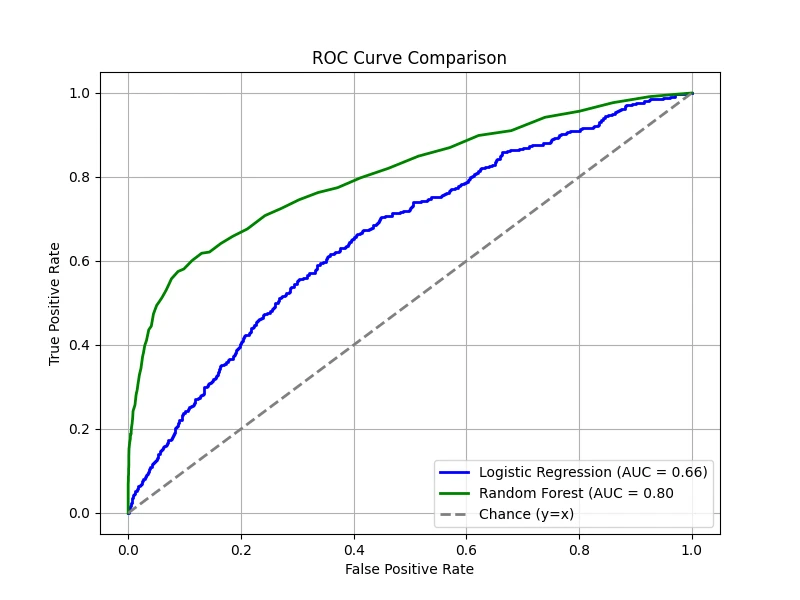
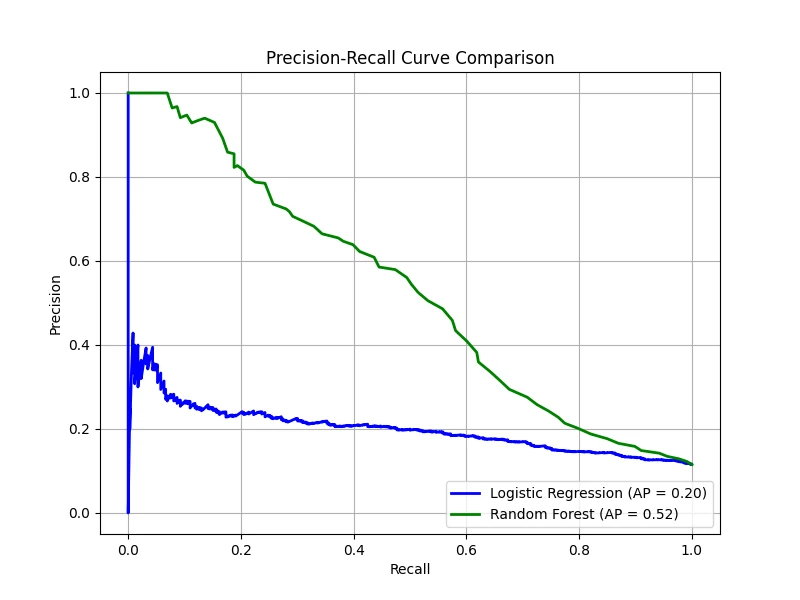
To demonstrate this effect, we create a dataset where 90% of the samples belong to the negative
class and only 10% belong to the positive class, then train both the logistic regression and
random forest models again:
ROC Curve (Imbalanced)
Precision-Recall Curve (Imbalanced)
The ROC curves remain relatively smooth and the AUC does not drop drastically, even though the dataset is highly
imbalanced. The PR curves, however, reveal a distinct difference, with noticeably lower AP scores. This highlights
how class imbalance makes it harder to achieve high precision and recall simultaneously. Even though the random
forest outperforms logistic regression, it still struggles to detect the rare positive cases effectively.
In summary, PR curves focus on precision and recall, which directly reflect how well a model identifies the minority class.
Precision, in particular, is sensitive to even a small number of false positives, and so gives a more realistic picture of
performance when the positive class is scarce. Thus,
PR-AP is often the preferred metric when the focus is on correctly identifying the minority class, for example in
fraud detection, rare-disease screening, or anomaly detection. When both classes are of comparable practical importance, ROC-AUC
remains an informative summary.
Connections to Machine Learning
The evaluation framework developed in this section is essential throughout applied machine learning. The
zero-one loss underlies the training objectives of many classifiers. The cross-entropy loss used in logistic
regression and neural networks can be understood as a smooth surrogate for it. ROC-AUC is a standard metric
for balanced classification tasks and is widely used in model selection. PR-AP (and its multi-class extension,
mAP) is the usual evaluation metric in object detection and information retrieval, where positive instances
are inherently rare.
The reject option introduced earlier is implemented in practice through confidence thresholding and is
increasingly important in safety-critical ML systems where abstaining from a prediction is preferable to making an error.