Polynomial Verifiability
The Hamiltonian cycle problem
illustrates an important phenomenon called polynomial verifiability. No known algorithm
determines in polynomial time whether a Hamiltonian cycle exists (the best known algorithms require exponential
time). Yet if someone hands us a proposed cycle, we can verify in polynomial time that it is indeed a
Hamiltonian cycle. We simply check that the graph has at least three vertices, that the cycle visits each vertex
exactly once, and that each consecutive pair, including the last and the first, is joined by an edge.
Definition: Verifiability
A verifier for a language \(A\) is an algorithm \(V\) such that
\[
A = \{w \mid V \text{ accepts } \langle w, c \rangle \text{ for some string } c\}.
\]
We measure the time of a verifier only in terms of the length of \(w\), so a polynomial-time verifier runs in
polynomial time in the length of \(w\). A language \(A\) is polynomially verifiable if it has
a polynomial-time verifier. The string \(c\) is called a certificate of membership in \(A\).
Since the verifier runs in time polynomial in \(|w|\), it reads at most polynomially many symbols of \(c\).
Replacing \(c\) by the prefix it reads leaves the computation unchanged, so we may always assume that the
certificate has length at most polynomial in \(|w|\).
The string \(c\) plays the role of additional information that supports the claim \(w \in A\). We may think of it
as a proof of membership presented by an external source. For the Hamiltonian cycle problem, a
certificate is a specific cycle, and the verifier performs exactly the check described above.
Nondeterministic Polynomial Time (NP)
Definition: Class NP
NP is the class of languages that have polynomial-time verifiers.
Definition: Nondeterministic Turing Machine
A nondeterministic Turing machine (NTM) is a 7-tuple
\((Q, \Sigma, \Gamma, \delta, q_0, q_{\mathrm{accept}}, q_{\mathrm{reject}})\) defined exactly as a
Turing machine except
that the transition function is multi-valued:
\[
\delta: Q \times \Gamma \to \mathcal{P}(Q \times \Gamma \times \{L, R\}),
\]
where \(\mathcal{P}(\cdot)\) denotes the power set.
At each configuration, the machine may have several possible next moves, so its computation forms a
computation tree rather than a linear sequence. A branch is a root-to-leaf
path in this tree.
An NTM \(N\) accepts input \(w\) if at least one branch of its computation
on \(w\) ends in state \(q_{\mathrm{accept}}\). It rejects \(w\) if all
branches halt in \(q_{\mathrm{reject}}\). The machine decides the language
\(L = \{w \mid N \text{ accepts } w\}\) in time \(t(n)\) if every branch on every input of length
\(n\) halts within \(t(n)\) steps.
There is an equivalent characterization of NP using NTMs, in which the certificate \(c\) is replaced by a
nondeterministic guess. We first name the nondeterministic time classes and then make the equivalence precise.
Definition: Nondeterministic Time Complexity Class
Let \(t\colon \mathbb{N} \to \mathbb{R}^+\) be a function. The nondeterministic time complexity
class \(\operatorname{NTIME}(t(n))\) is the collection of all languages that are decidable by an
\(O(t(n))\)-time nondeterministic Turing machine.
Theorem: Verifier-NTM Equivalence
A language \(A\) is in NP if and only if some nondeterministic polynomial-time Turing machine decides
\(A\). Consequently,
\[
NP = \bigcup_{k \in \mathbb{N}} \operatorname{NTIME}(n^k).
\]
Proof.
(\(\Rightarrow\)) Verifier \(\Rightarrow\) NTM. Suppose \(A\) has a polynomial-time
verifier \(V\) running in time \(n^k\) on inputs \(\langle w, c \rangle\) of length \(|w| = n\). By
the certificate-length bound established in
Verifiability, we may assume \(|c| \leq n^k\).
Construct an NTM \(N\) that, on input \(w\):
- Nondeterministically writes a string \(c\) of length at most \(n^k\) on the tape (branching over the
symbol written at each of at most \(n^k\) steps).
- Simulates \(V\) on \(\langle w, c \rangle\), accepting if and only if \(V\) accepts.
Step 1 takes \(O(n^k)\) steps, and so does step 2. The total time per branch is \(O(n^k)\), polynomial in
\(n\). Some branch of \(N\) accepts \(w\) if and only if some certificate \(c\) makes \(V\) accept
\(\langle w, c \rangle\), and by the definition of a verifier this happens exactly when \(w \in A\).
(\(\Leftarrow\)) NTM \(\Rightarrow\) Verifier. Suppose an NTM \(N\) decides \(A\) in
time \(n^k\). Define a deterministic verifier \(V\) that, on input \(\langle w, c \rangle\):
- Interprets \(c\) as a sequence of nondeterministic choices, one per step of \(N\).
- Simulates \(N\) on \(w\) following the choices encoded by \(c\), accepting if and only if this branch
ends in \(q_{\mathrm{accept}}\).
Each step of \(N\) has at most \(b := \max_{q,a} |\delta(q,a)|\) choices, which is a finite constant since
\(Q\) and \(\Gamma\) are finite. Hence \(c\) of length \(O(n^k \log b) = O(n^k)\) suffices to encode any
branch. The simulation runs in time polynomial in \(|w|\). The verifier \(V\) accepts \(\langle w, c \rangle\)
for some \(c\) if and only if some branch of \(N\) accepts \(w\), that is, if and only if \(w \in A\).
P vs NP Question
Recall that P is the class of
languages for which membership can be decided in polynomial time, while
NP is the class of languages for which membership
can be verified in polynomial time.
Problems like the Hamiltonian cycle problem are known to be in NP but are not known to be in P. Intuitively,
verifying a solution should be easier than finding one. No proof of this intuition is known. The question of
whether \(P = NP\) or \(P \neq NP\) is one of the most important open problems in mathematics and computer
science, listed among the Clay Mathematics Institute's Millennium Prize Problems (with a prize of
one million US dollars). Most researchers believe that \(P \neq NP\).
Definition: Class EXPTIME
EXPTIME is the class of languages decidable in exponential time on a deterministic
single-tape Turing machine:
\[
\operatorname{EXPTIME} = \bigcup_{k \in \mathbb{N}} \operatorname{TIME}(2^{n^k}).
\]
What is known is the chain of containments
\[
P \subseteq NP \subseteq \operatorname{EXPTIME}.
\]
Neither inclusion is known to be strict on its own. At least one of them must be, however, since the time
hierarchy theorem, which we do not prove here, gives \(P \neq \operatorname{EXPTIME}\). The two containments are
established by the following theorems.
Theorem: \(P \subseteq NP\)
Every language in P is in NP. That is, \(P \subseteq NP\).
Proof.
Let \(A \in P\) and let \(M\) be a deterministic polynomial-time Turing machine deciding \(A\). Define a
verifier \(V\) that, on input \(\langle w, c \rangle\), ignores \(c\) and simulates \(M\) on \(w\), accepting
if and only if \(M\) accepts. Since \(M\) runs in polynomial time, so does \(V\). For any \(w \in A\), every
\(c\) (including the empty string) is a valid certificate, whereas for any \(w \notin A\), no \(c\) leads
\(V\) to accept. Hence \(V\) is a polynomial-time verifier for \(A\), so \(A \in NP\).
Theorem: \(NP \subseteq \operatorname{EXPTIME}\)
Every language in NP is in EXPTIME. That is, \(NP \subseteq \operatorname{EXPTIME}\).
Proof.
Let \(A \in NP\). By
Verifier-NTM Equivalence, some NTM \(N\)
decides \(A\) in time \(n^k\) for some constant \(k\). Construct a deterministic TM \(D\) that, on input \(w\)
of length \(n\), simulates every branch of \(N\) on \(w\) by exhaustive breadth-first search of the
computation tree. Since every branch of \(N\) halts within \(n^k\) steps and each step offers finitely many
choices, the tree is finite and \(D\) halts on every input. The machine \(D\) accepts exactly when some branch
of \(N\) accepts, so \(D\) decides \(A\).
Write \(b := \max_{q,a} |\delta(q,a)|\) for the maximal number of choices of \(N\) at a single step, a finite
constant determined by \(N\). The computation tree of \(N\) on \(w\) has depth at most \(n^k\), so it contains
at most \(b^{n^k}\) branches. Simulating one branch takes \(O(n^k)\) steps, so the total time is
\[
O(n^k \cdot b^{n^k}) = O(n^k \cdot 2^{n^k \log_2 b}) = 2^{O(n^k)}.
\]
Hence \(D\) runs in time \(2^{c \cdot n^k}\) for some constant \(c \geq 1\), so that
\(2^{c \cdot n^k} \geq n\). If \(D\) uses several tapes, the
single-tape simulation
turns it into a single-tape machine running in time \(O(2^{2c \cdot n^k})\), so after enlarging \(c\) we may
take \(D\) single-tape. For \(n \geq c\), the running time \(2^{c \cdot n^k}\) is bounded by \(2^{n^{k+1}}\),
so \(A \in \operatorname{TIME}(2^{n^{k+1}}) \subseteq \operatorname{EXPTIME}\).
NP-Completeness
Some problems in NP are as hard as any problem in NP. Solving any one of them in polynomial time would
imply \(P = NP\). These are the NP-complete problems. The Hamiltonian cycle problem is one
example. Its NP-completeness is a classical result that we state without proof, since establishing it requires a
chain of reductions beginning with the Cook-Levin theorem. We make the general transfer principle precise below.
Definition: Polynomial Time Reduction
Language \(A\) is polynomial-time reducible to language \(B\), denoted
\[
A \leq_{P} B,
\]
if a polynomial-time computable function \(f: \Sigma^* \to \Sigma^*\) exists such that
\[
w \in A \iff f(w) \in B \quad \text{for all } w \in \Sigma^*.
\]
The function \(f\) is called a polynomial-time reduction of \(A\) to \(B\).
Here, a function \(f\) is polynomial-time computable if there exists a polynomial-time
Turing machine \(M\) that, on any input \(w\), halts with \(f(w)\) on its tape.
Definition: NP-Completeness
A language \(B\) is NP-complete if it satisfies the following two conditions:
- \(B\) is in NP.
- Every language \(A\) in NP is polynomial-time reducible to \(B\) (that is, \(A \leq_P B\)).
A language satisfying condition 2 (but not necessarily condition 1) is called NP-hard.
Theorem: Reduction Transfers Tractability
If \(A \leq_P B\) and \(B \in P\), then \(A \in P\). Consequently, if any NP-complete language
belongs to P, then \(P = NP\).
Proof.
Part 1. Let \(f\) be a polynomial-time reduction from \(A\) to \(B\), computable by a TM
\(M_f\) in time \(O(n^j)\). Let \(M_B\) be a polynomial-time decider for \(B\) running in time \(O(m^k)\) on
inputs of length \(m\). Enlarging the exponents if necessary, we may assume \(j, k \geq 1\). Define a decider
\(M_A\) for \(A\) that, on input \(w\) of length \(n\):
- Computes \(f(w)\) using \(M_f\), in time \(O(n^j)\).
- Runs \(M_B\) on \(f(w)\), accepting if and only if \(M_B\) accepts.
Since \(M_f\) writes at most \(O(n^j)\) symbols, \(|f(w)| = O(n^j)\). Step 2 then runs in time
\(O((n^j)^k) = O(n^{jk})\). The total time is therefore \(O(n^j + n^{jk}) = O(n^{jk})\), which is polynomial
in \(n\). By \(A \leq_P B\), \(w \in A \Leftrightarrow f(w) \in B\), so \(M_A\) decides \(A\). Hence
\(A \in P\).
Part 2. Suppose \(B\) is NP-complete and \(B \in P\). For any \(A \in NP\), condition 2 of
NP-completeness yields \(A \leq_P B\), and Part 1 then gives \(A \in P\). Hence \(NP \subseteq P\), and
together with \(P \subseteq NP\) we conclude
\(P = NP\).
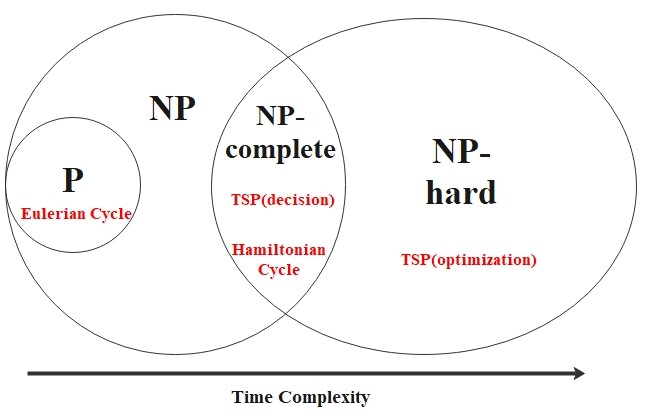
To illustrate, we introduce the closely related Traveling Salesperson Problem.
Example: Traveling Salesperson Problem (TSP), Decision Version
Given a set of cities, the distances between them, and a number \(d\), is there a tour that visits each city
exactly once, returns to the starting city, and has total distance \(\leq d\)?
The decision version of TSP is a classical NP-complete problem (proved via reduction from the Hamiltonian cycle
problem). The optimization version asks for a tour of minimum total distance rather than testing
whether one of total distance \(\leq d\) exists. It is not a language, so it is not in NP and cannot be
NP-complete. Nevertheless it is NP-hard in the extended sense that a polynomial-time algorithm
for it would place the NP-complete decision version in P, and hence give \(P = NP\).
Under the widely believed assumption that \(P \neq NP\), the landscape of complexity classes is as follows:
Aside: Collapse Under \(P = NP\)
If \(P = NP\), then every language in P other than \(\varnothing\) and \(\Sigma^*\) is NP-complete.
To see why, let \(A \in P\) be any nontrivial language (so there exist strings \(a^+ \in A\) and
\(a^- \notin A\)). For any \(B \in NP = P\), let \(M_B\) be a polynomial-time decider for \(B\). The map
\[
f_B(w) = \begin{cases} a^+ & \text{if } M_B \text{ accepts } w, \\ a^- & \text{otherwise} \end{cases}
\]
is a polynomial-time reduction \(B \leq_P A\). Combined with \(A \in NP\), this makes \(A\) NP-complete.
Conversely, neither \(\varnothing\) nor \(\Sigma^*\) is NP-complete, since only \(\varnothing\) reduces to
\(\varnothing\), only \(\Sigma^*\) reduces to \(\Sigma^*\), and NP contains both of these languages. Hence
under \(P = NP\):
\[
\text{NP-complete} = P \setminus \{\varnothing, \Sigma^*\}.
\]
Math \(\leftrightarrow\) CS: Living with Intractability
NP-completeness theory has profound practical implications. When an industrial problem in scheduling, routing,
network design, or resource allocation is shown to be NP-complete, an exact polynomial-time algorithm is
almost certainly out of reach. The response is not to give up but to change the question.
Practitioners turn to approximation algorithms with provable suboptimality bounds,
heuristics such as simulated annealing or genetic algorithms, fixed-parameter
tractable solvers for restricted inputs, and SAT/SMT solvers that exploit problem
structure despite worst-case exponential behavior. The boundary between P and NP-complete thus redirects
engineering effort toward these alternatives.